

“Placeholder: a verbatim Google review from a musician patient goes here.”
Repetitive Strain and Musician Injury Physical Therapy in Corvallis
If playing has started to hurt, you are dealing with a repetitive strain problem, and repetitive strain responds well to physical therapy.
At a glance
Encore Physical Therapy treats repetitive strain and overuse injuries in musicians at 2609 NW 9th Street in Corvallis, Oregon. Care covers hand, wrist, forearm, neck, shoulder, and TMJ pain from playing. Oregon direct access means most patients can start without a doctor's referral. Medicare and most commercial insurance accepted. Call (541) 758-2235.
- Evaluations within a couple of weeks, not months on a waiting list
- Direct access clinic. In Oregon you can usually start PT without a doctor's referral
- Medicare and most commercial insurance accepted. Cash pay available
- One-on-one evaluation with a licensed physical therapist, not a hand-off
Common Injuries We Treat
Instrument pain rarely arrives as a single event. It builds with hours of repeated, precise work held in one posture.
Strings and keyboard
- Hand, finger, wrist and forearm pain
- Shoulder and rotator cuff irritation
- Neck pain from holding posture
Wind and brass
- Jaw pain, clicking and TMJ
- Rib and upper-back stiffness that limits a full breath
- Shoulder and arm strain from holding height
Percussion
- Forearm, elbow and wrist pain
- Shoulder overuse
- Low back and hip pain from long seated sets
Not sure which of these describes what you're feeling? Call (541) 758-2235 and we'll talk it through.
Every condition we see, in detail
We evaluate and treat the hand, wrist, forearm, neck, shoulder, and jaw pain that builds up over hours of practice, and we build a plan around getting you back to the instrument rather than away from it.
Strings and keyboard
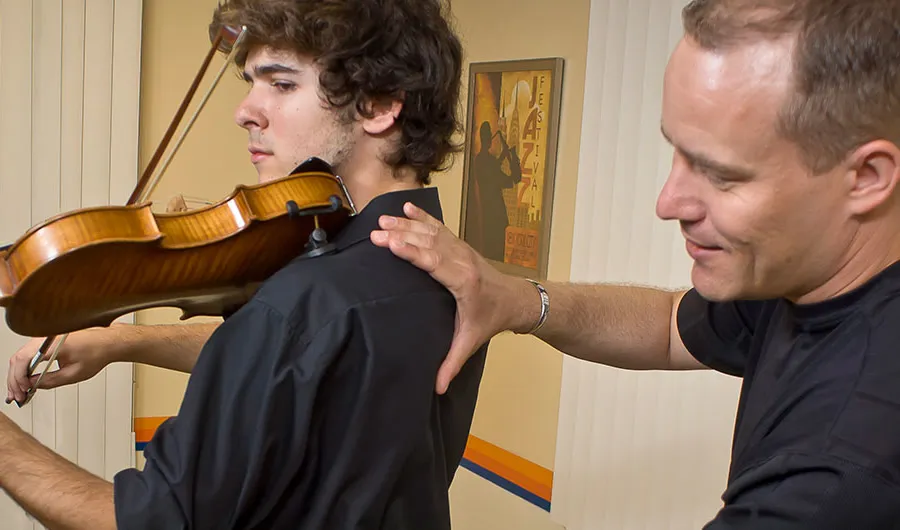
Violin, viola, cello, bass, guitar, and piano all put the hands and forearms into sustained, repeated, fine-motor work while the neck and shoulders hold a posture that does not change much for hours. The complaints that come out of that pattern are the ones we treat every week under other names.
- Hand and finger pain, including minor finger and hand injuries
- Wrist and forearm pain from repeated gripping, pressing, and bowing
- Shoulder pain and rotator cuff irritation, common on the bow-arm or elevated-shoulder side
- Neck pain from sustained instrument-holding posture
- Posture problems and thoracic stiffness that show up as fatigue before they show up as pain
The evaluation looks at the whole chain, not just the finger that hurts, because a wrist that is doing extra work is often compensating for a shoulder blade or a mid-back that is not moving.
Wind, brass, and jaw
Wind and brass players load the jaw, the neck, and the breathing mechanics in ways most clinics do not think to ask about. Embouchure demand, instrument weight held out in front of the body, and hours of controlled breathing add up.
We provide TMJ therapy as a standing service, which means jaw pain, clicking, limited opening, and the headaches that often travel with them are treated here rather than referred out. Alongside that we address neck pain, upper-back and rib stiffness that restricts a full breath, and the shoulder and arm strain that comes from holding an instrument at height.
If jaw or neck pain is your main complaint, say so when you call at (541) 758-2235 so we can route your evaluation accordingly.
Percussion
Percussion is impact plus repetition, and it travels up the arm. Grip pressure, stick rebound, pedal work, and the sheer volume of reps produce forearm and elbow pain, wrist irritation, shoulder overuse, and low back and hip complaints from long stretches seated at a kit.
These are the same soft tissue injuries to muscle, tendon, and ligament that we treat in the rest of our sports medicine practice, and they respond to the same principles: find the source, calm the tissue down, then rebuild tolerance so the load stops causing damage.
How These Injuries Happen
Instrument pain builds: a small ache that shows up earlier each session, then is there when you wake. A lot of repetitive-strain care treats the sore spot and stops. We look for what's driving the load and teach you your own mechanics, so you can catch the pattern before it comes back.
Why it happens, in detail
Instrument pain almost never arrives as a single event. It builds. You notice a little ache in the left thumb, then it shows up earlier in the session, then it is there when you wake up. By the time most people call a clinic, they have already tried resting, changing their setup, and pushing through.
Two things make this harder than it should be. The first is access. Getting an evaluation booked with the large groups in town can take a while, and pain that has been ignored for two months does not get simpler in month three. We can typically schedule an evaluation within a couple of weeks. The second is that a lot of care aimed at repetitive strain treats the sore spot and stops there. We do not chase symptoms. We look for what is actually driving the load, and we teach you enough about your own mechanics that you can recognize the pattern before it comes back.
We Have a Musical Instrument Injury Specialist
Chris Guempel, PT, MPT, earned a Bachelor's of Music in Cello Performance at the University of Louisville and continued studying music in Mainz, Germany before switching careers and finishing his physical therapy degree in December 2001. He opened Encore in 2009.
Why that background matters
That background matters here for one plain reason. A therapist who has spent hours a day holding a fixed position under a bow understands why "just take six weeks off" is not a useful answer for someone with an audition, a recital, a gig, or a jury coming up. You can read Chris's full story on his bio page.

“Came in with really debilitating sciatic pain and left with my mobility and sleep returned to me. So grateful to Chris and Aaron for all their work with me!”
What Care Looks Like at Encore
Treatment depends on the diagnosis, not on a template, and the plan is built with you.
- A one-on-one evaluation A licensed physical therapist looks at the whole chain, not just the finger that hurts, to find which treatment fits.
- Hands-on treatment Skilled joint and soft-tissue work, with heat, cold, ultrasound or taping when they help.
- Exercise, in clinic and at home Prescriptive exercise restores flexibility, strength and integrity to the affected area.
- A plan that adjusts Hands-on work integrated with exercise, and a quick change of course if you aren't improving.
The hands-on techniques we use
Treatment depends on the diagnosis, not on a template. What stays consistent is that your evaluation is one-on-one with a licensed physical therapist, and the plan gets built with you.
- A thorough evaluation to identify which treatment options actually fit your problem
- Manual therapy, meaning skilled hands-on treatment of joints and soft tissue. Our team draws on methods from Geoffrey Maitland, Robin McKenzie, Freddie Kaltenborn, Brian Mulligan, Strain Counterstrain, Muscle Energy, and the North American Institute of Manual Therapy
- Prescriptive exercise done in the clinic and at home to restore flexibility, strength, and integrity to the affected area
- Therapeutic modalities such as heat or cold early on to reduce pain and inflammation
- Ultrasound (deep heat delivered by sound waves) or electrical stimulation where it helps reduce pain or improve muscle activity
- Taping where it supports healing or gives you feedback about position
Chris's stated approach is hands-on work integrated with exercise, and a willingness to change course quickly if you are not reporting improvement. That last part is the important one.
Getting back to playing
- Find how much you can play now without symptoms
- Treat the underlying problem
- Rebuild playing time toward your rehearsal calendar
More on getting back
Total rest is rarely the plan. Deconditioned tissue does not tolerate a return to a full practice schedule any better than injured tissue did, and most musicians cannot afford to disappear for two months anyway.
What we do instead is work out how much you can play right now without provoking symptoms, then rebuild capacity from there while treating the underlying problem. That means talking about your actual repertoire, your session length, your rehearsal calendar, and what you are preparing for. You participate in setting the goals, because a goal of "no pain" and a goal of "play the second movement at tempo by March" call for different plans.
If you are also recovering from surgery, our rehabilitation page covers pre- and post-surgical care in more detail.
Staying ahead of it
Once the pain settles, the work shifts to keeping it settled. That usually involves strength and endurance for the muscles that support long practice sessions, mobility where you have lost it, and a clear understanding of the warning signs that used to sneak up on you.
We take education seriously. We would rather you leave knowing why your forearm was complaining and what to do about it at the first twinge than come back in eighteen months for the same problem. If you want a structured plan built before something hurts, that falls under injury prevention and conditioning.
Who You’ll Work With
Your evaluation is done by a licensed physical therapist, and you see familiar faces through your plan of care rather than a new person each visit.
Chris Guempel, PT, MPT
owner, physical therapist since 2001, founded Encore in 2009
Kathy Lynch, PT, DPT
Doctor of Physical Therapy, continuing education in cervical, lumbopelvic and sports injuries, SFMA trainedNathan Smith, PT, MPT
physical therapist
Tiesha Oare, PTA
physical therapist assistant, joined Encore in 2020
Aaron Nobiletti, PTA
physical therapist assistant, background in exercise science
Read reviews in our patients' words
Every review on our Google Business Profile is public, unedited, and written by the people we've treated and cared for. We're honored to have received nearly 200 five-star reviews, and to have helped each of those people reach a health goal.
“Placeholder: a verbatim Google review from a musician patient goes here.”
“Placeholder: a verbatim Google review from a musician patient goes here.”
Questions musicians ask
Do I need a doctor's referral to be seen?
Usually not. Oregon is a direct access state, so most patients can self-refer and start physical therapy without a referral. Call (541) 758-2235 and we will check your specific plan.
How soon can I get an evaluation?
We can typically schedule an evaluation within a couple of weeks. Reception works to get back to you within a business day to book the appointment.
Will you tell me to stop playing?
That is not the default. We work out how much playing you can tolerate without provoking symptoms, treat the underlying problem, and rebuild from there. Complete rest is only recommended when the diagnosis genuinely calls for it.
Is this covered by insurance?
We accept Medicare and most commercial insurance, and cash pay is available. We will verify your plan and explain your coverage before you commit to a course of care.
What happens at my first visit?
Your first visit is a one-on-one evaluation with a licensed physical therapist. We'll talk through what happened and what you want to get back to, look at how you move to find the source of the problem, and then explain what we found and what your plan looks like.
What should I bring?
Your insurance card and a photo ID, a list of the medications you take, and any paperwork from your surgeon or doctor, including post-op instructions or a referral if you have one. Wear clothes that let us see and move the area we're treating: shorts for a knee or hip, a loose shirt or tank top for a shoulder.
Where to Go Next
Ready When You Are
Get Back to Your Life
Recover stronger. Move better. Stay active. Whether you're recovering from surgery or an injury, managing chronic pain, or working to prevent future injuries, contact us today to get started.